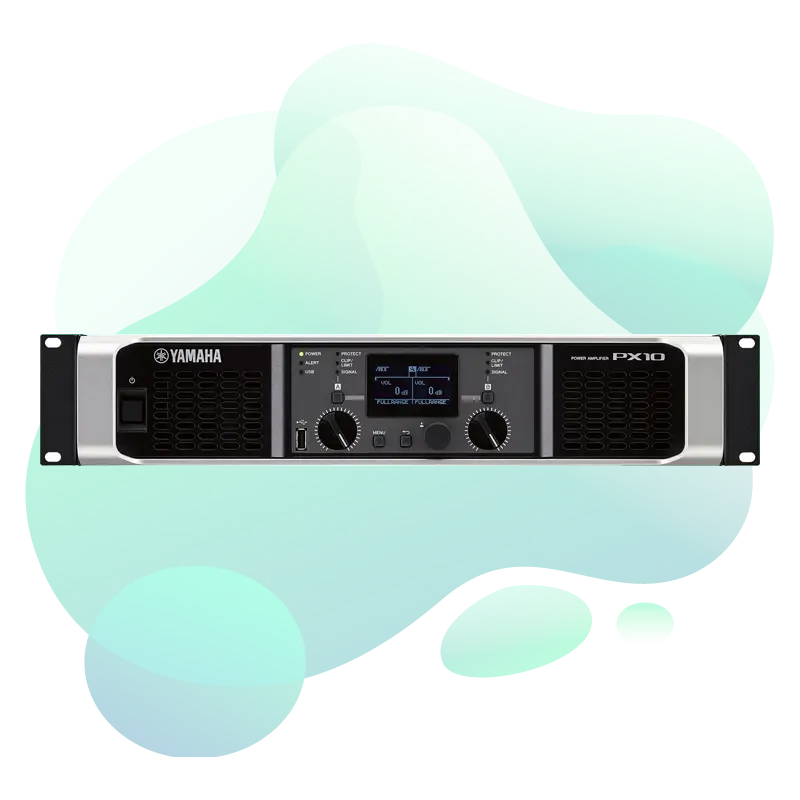

PX10
Yamaha PX10 Two-Channel Power Amplifier
2-channel 1000W/8Ω Class D power amplifier with onboard DSP, crossover, PEQ, delay, and speaker presets. Designed for demanding subwoofer and full-range applications in fixed-installation and high-performance home cinema environments.
Overview
The Yamaha PX10 is a professional-grade 2-channel Class D power amplifier delivering 1000W per channel at 8Ω and 1200W per channel at 4Ω. Built around Yamaha's custom single-chip Class D engine with PLL-based real-time transfer characteristic control, the PX10 maintains consistent performance under varying load conditions — making it particularly well-suited to high-excursion subwoofer drivers and demanding low-frequency applications in home cinema environments. Onboard DSP includes configurable HPF/LPF crossovers, 6-band parametric EQ, per-channel delay, output limiters, and Yamaha speaker presets for CBR, Club, Installation, VXS, and VXC series passive speakers. The flexible Amp Mode routing (FULL+FULL, SUB+SUB, FULL+SUB, Bi-Amp) enables the PX10 to serve as a dedicated subwoofer amplifier, a biamp channel amplifier, or a standard stereo power amplifier without external signal processing hardware. Settings can be saved to eight onboard presets and transferred via USB thumb drive for multi-unit deployments or installer backup workflows. A USB port also supports firmware updates, keeping the unit current with Yamaha's speaker preset database as new products are released. Panel locking prevents accidental changes once commissioned.
Pros & Cons
Strengths
- High output power for demanding subwoofer applications
- Onboard DSP eliminates need for separate crossover hardware
- Flexible routing modes suit both subwoofer and full-range configurations
- USB preset transfer speeds up multi-unit commissioning
- Strong price-to-performance ratio for professional-grade Class D output
Limitations
- No AES/EBU or Dante digital audio input — analog only
- No bridged/BTL mode (Power Boost not available on PX10)
- 6-band PEQ requires firmware v1.5 or later and Advanced Mode
Full Specifications
Power Output
Audio Performance
Gain & Input
DSP & Processing
Connectors
Power & Physical
Integrating the Yamaha PX10 into Home Cinema and Subwoofer Systems
The Yamaha PX10 is a strong choice for high-performance home cinema subwoofer amplification, particularly in systems using passive subwoofer drivers such as the Krix Cyclonix, MX-30, or MX-40 series. Its SUB+SUB routing mode allows both channels to receive a dedicated LFE signal from a processor, while the onboard HPF/LPF crossover and 6-band PEQ can replace a separate active crossover in two-way speaker configurations. At Kolosseum, the PX10 is typically specified alongside Trinnov or StormAudio processors where the processor's bass management feeds the PX10's XLR inputs directly.
Room Requirements
Rack space of 2U minimum. Rear-to-front airflow clearance of at least 100mm is recommended at the rear panel. The amplifier should be mounted with space for the cable harness at rear XLR and speakON connectors.
Recommended Screen Pairing
As a dedicated amplifier, the PX10 is agnostic to display technology and integrates into the audio infrastructure independent of projector or screen selection.
Acoustic Considerations
When used in SUB+SUB mode, subwoofer calibration should be performed using the processor's bass management and room correction tools (e.g. Trinnov Optimizer or Dirac Live) after the PX10's onboard HPF is set. Avoid stacking PEQ corrections across both the amplifier and the processor to prevent phase complications.
Frequently Asked Questions About the Yamaha PX10 Two-Channel Power Amplifier.
Yes. The PX10 includes a SUB+SUB routing mode where both channels receive an identical LFE or subwoofer signal, each driving a separate passive subwoofer driver independently. The onboard LPF crossover can be configured to pass only the frequencies appropriate for your subwoofer driver.
No. Unlike the PX5 and PX3, the PX10 does not include a Power Boost (bridged mono) mode. Each channel operates independently at up to 1000W into 8Ω.
The PX10 accepts only analog inputs — balanced XLR and unbalanced ¼" TRS. There is no AES/EBU, S/PDIF, Dante, or AES67 digital audio input on this model.
Configuration is done via the front panel controls and USB-connected PC with Yamaha's ProVisionaire Control software, or by loading presets via USB thumb drive. Eight user presets can be saved and recalled. The Config Wizard guides initial setup and automatically assigns speaker presets for compatible Yamaha passive speakers.
The Yamaha PX10 is priced at AUD $1,799 RRP in Australia.
The PX10 pairs well with high-power passive subwoofer drivers including the Krix Cyclonix 15, Cyclonix 18, MX-30 Sub, and MX-40 Sub. Its 1000–1200W per channel output and onboard LPF crossover make it suitable for any passive subwoofer requiring clean high-power amplification.
Compare Alternative Electronics.
PA 16
16-channel power amplifier designed to pair with StormAudio ISP processors. Delivers high-current amplification across all channels for demanding multi-channel cinema speaker systems.
View Details →Hyperion Hepta
Premium Class-H 7-channel amplifier with Dante-enabled connectivity, 230W/ch at 8 ohms, 300W/ch at 4 ohms, and 600W bridged mono capability.
View Details →Hyperion Penta
Premium Class-H 5-channel amplifier with Dante-enabled connectivity, 230W/ch at 8 ohms, 300W/ch at 4 ohms, and 600W bridged mono capability.
View Details →Ready to Design Your Cinema Around the PX10?
Kolosseum is an independent design consultancy, not a retailer. We design the complete cinema experience and connect you with authorized dealers for purchase and professional installation.
Tell us about your room, your budget, and your vision. We will create a complete cinema design that integrates the Yamaha PX10 Two-Channel Power Amplifier with the right screen, speakers, acoustics, and seating.