For Integrators

Smart Home
Documentation & Engineering

We become your white label engineering department. Scale your capacity without scaling your overhead.

Engineering Support

01

Rack Engineering

Precise rack elevations, thermal load calculations, and cable schedules. We ensure your technicians have a clear map to build the head-end.

02

Schematic Design

Single-line schematics and signal flow diagrams. We define every connection from source to display, ensuring system integrity.

03

As-Built Documentation

Post-installation updates to reflect the reality of the site, providing a permanent record for future service.

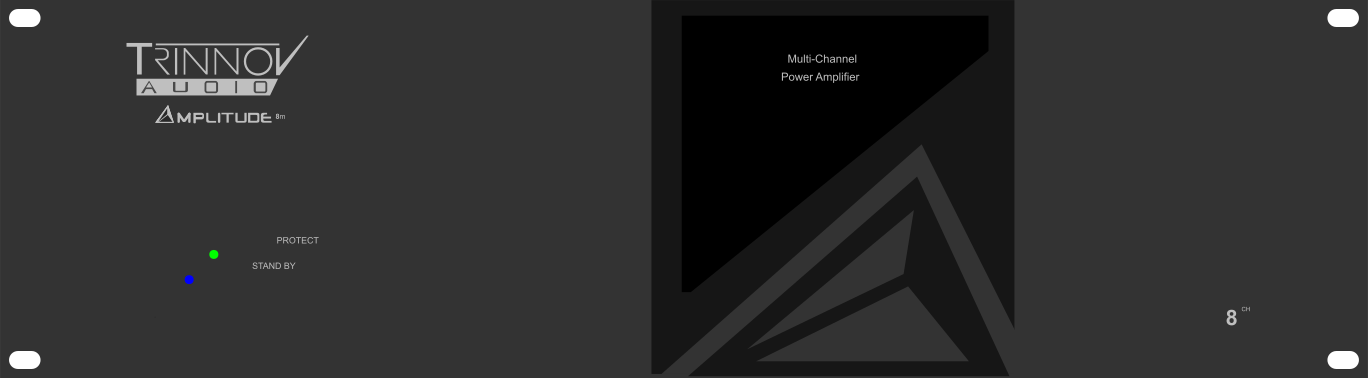
18RU rack frame
RACK01-furman
RACK01-amp-1
RACK01-vent-1
RACK01-amp-2
RACK01-vent-2
RACK01-altitude
RACK01-madvr
RACK01-kaleidescape-terra
RACK01-kaleidescape-strato
RACK01-ubiquiti
RACK01-crestron
Automation Engineering

Documentation Tiers

5.0 Average — 32 Verified Projects

Three distinct tiers of engineering documentation to suit project scale and complexity, from basic rack layouts to complete system programming.

Core
Level 1

Core

Foundational

The three documents that define what gets installed, where it goes, and how it connects — before a single cable is pulled.

  • Cable Run List
  • Annotated Floor Plan
  • Schematic Diagram
  • System Architecture
  • Signal Flow Definition

From AUD$3999

Select Core
Most Popular
Fusion
Level 2

Fusion

Professional

Everything in Core plus a cable-by-cable cabling schedule and complete infrastructure specification document covering standards, network architecture, and integration points.

  • Everything in Core
  • Detailed Cabling Schedule
  • Termination Standards
  • Infrastructure Specification
  • Network Architecture & IP Plan
  • Integration Points Schedule

From AUD$4999

Select Fusion
Apex
Level 3

Apex

Mastery

Everything in Fusion plus rack layouts drawn to scale, front and rear device panel detail, and block diagrams with all inputs, outputs, and connection terminal identification.

  • Everything in Fusion
  • Rack Layout Drawings
  • Front-Panel Device Detail
  • Rear-Panel & Terminal IDs
  • Block Diagrams — I/O
  • Cross-Referenced Document Set

From AUD$6999

Select Apex
Industry Knowledge

Smart home control systems explained

Home automation is an unregulated industry with significant variance in quality. These are the questions that separate a functioning system from an expensive mistake.

These answers reflect Kolosseum's engineering position. Every project has unique requirements — the right specification for your home requires a proper design engagement with a certified integrator.

Start a Project
Verified Performance

Client Experiences with
Automation Engineering Packages.

5 / 5.0
Based on 32 Reviews

The IP plan and network topology we received for the Toorak project was flawless. It saved us countless hours during the commissioning phase.

Jason Miller

Integration Manager, Perth

Kolosseum is our go-to for complex rack elevations and signal flow diagrams. Their work is the gold standard for luxury integration.

Robert Vance

Project Director, Gold Coast

Ecosystem Integration

Technology We Design Around

Every automation system we document is engineered around the specific control platform and sub-systems that will operate inside the home. Processor selection, network topology, integration protocol, cable type, and rack allocation are resolved as part of the documentation — not chosen afterwards. The platforms and technologies listed here are those we encounter most frequently in professional residential integration work across Australia.

01

Whole-Home Control Platforms

The control processor is the overarching layer that ties every sub-system together — lighting, audio, video, climate, security, blinds, and access control — into a single unified interface. We document integration architecture for Control4 (OS 3, EA and CA series processors), Crestron (Crestron Home, CP4 and MC4 processors), Savant (Smart Host, Pro Host, and Savant Power modules), RTI (XP series processors and T4x touchscreens), and ELAN (gSC controllers and HR series remotes). Our documentation is platform-agnostic — we produce the engineering set that allows the integrator to deploy whichever system they specify.

02

Lighting Control Systems

Lighting control is typically the largest sub-system by circuit count and the one with the most architectural impact. We document systems across Lutron (HomeWorks QSX, RadioRA 3, Caseta), Clipsal C-Bus, Philips Dynalite, DALI-2 (via Zencontrol, ABB, Schneider Electric, and Zennio gateways), and KNX-based systems from Theben, ABB, and Basalte. Each system has distinct wiring requirements, dimming protocols, and switchboard allocation needs — all of which are resolved in our documentation before a cable is pulled.

03

Distributed Audio & Video Systems

Multi-room audio and video distribution is documented as part of the control system architecture. For audio, we specify and document systems from Sonos (architectural and Port-based), Sonance, SpeakerCraft, Triad, Episode, and Origin Acoustics — including in-ceiling, in-wall, invisible, and outdoor speaker placements. For video distribution, we document HDMI over IP (using Blustream, Binary, Just Add Power, or Crestron DM NVX), matrix switching, and source device allocation.

04

Network Infrastructure & Structured Cabling

The network is the backbone of every modern smart home. We document enterprise-grade network architecture including managed switching, wireless access point placement, VLAN segmentation, PoE budgeting, and IP allocation plans. Network hardware commonly specified includes Ubiquiti UniFi, Araknis (Snap One), Ruckus, Cisco Meraki, and Pakedge. Structured cabling is specified per run — Cat6A for data and control, fibre for long backbone runs, RG6 for legacy video, and dedicated speaker cable per zone.

05

Security, CCTV & Access Control

Security integration is documented as part of the whole-home control topology. We specify integration points for alarm systems (Inception, NESS, Bosch, DSC), CCTV and surveillance (Axis Communications, Hikvision, Dahua, UniFi Protect), and access control (keyless entry, biometric readers, smart locks from Yale, August, and Suprema). Integration with the control processor — allowing camera feeds on touchscreens, alarm arming via scenes, and door lock control via app — is documented with specific driver references and IP addressing.

06

Climate Control, Motorised Blinds & Ancillary Systems

We document the integration of HVAC systems (ducted, split, VRV/VRF) via CoolAutomation, IntesisHome, or native control drivers. Motorised blinds and curtains from Somfy, Rollease Acmeda, and Lutron Palladiom are documented with motor specification, relay allocation, and scene integration. Pool and spa control (Pentair, Astral), fireplace automation (Escea, Real Flame), irrigation control, and garage door integration are each specified with the appropriate control protocol, cabling requirement, and integration point in the master schedule.

07

Why Documentation Matters for Professional Integrators

The Australian residential integration industry is served by CEDIA-member dealers, electricians, and specialist technology companies who deploy these systems into homes valued from $1 million to $30 million and above. The complexity of a modern smart home — often comprising 150 to 300 networked devices across lighting, audio, video, security, climate, and access control — demands engineering documentation of the same standard expected in commercial fit-outs. Our documentation gives integrators a complete, defensible engineering reference: cable schedules that the electrician can price from, rack layouts the technician can build from, and network architecture that any future dealer can service from.

Ready to Automate?

Start your project today and experience professional automation engineering.

Start Your Project