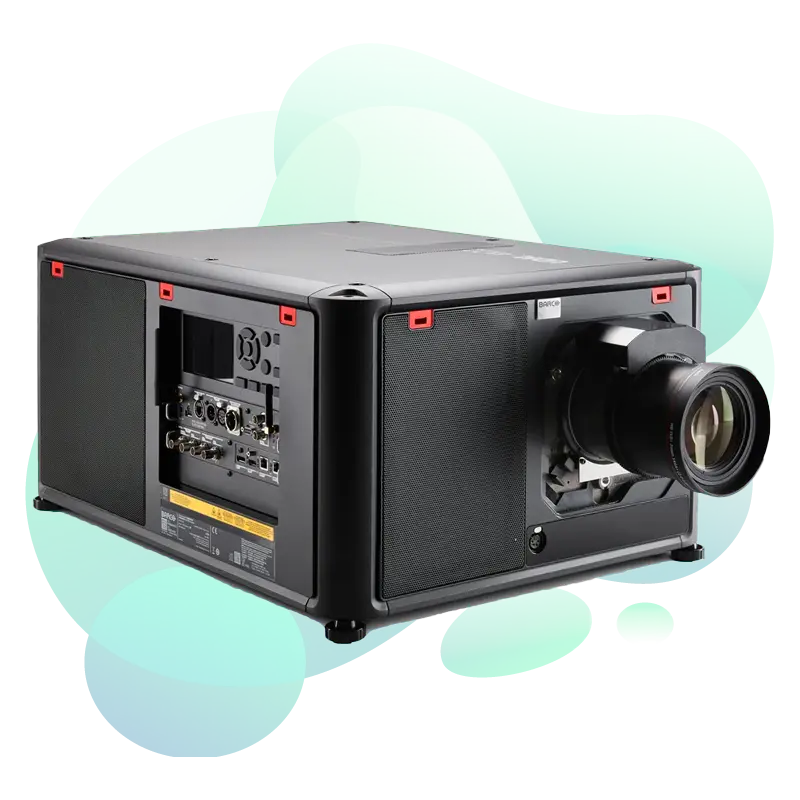

Hodr
Barco Residential Hodr — Theater & Media Room Series
Three-chip DLP laser phosphor projector with 4K UHD (3,840 × 2,160), up to 7,500 ANSI lumens with Light on Demand flexibility down to 4,000 lumens, 20,000:1 DynaBlack contrast, and P7 RealColor DCI/P3 colour. Theatre & Media Room Series. Designed for medium-to-large residential screening rooms demanding cinema-grade colour accuracy at high output. Pricing on application.
Overview
Höðr (anglicised as Hodr) is a figure from Norse mythology — the blind god, guided by others, whose precise aim in the darkness is guided by the light of his fellow gods. In Barco's residential line, the Hodr is the projector that bridges the gap between the accessible brightness of the Pulse Series and the extreme output of the Njord: a three-chip DLP instrument with cinema-grade colour fidelity, designed for the rooms and screens that single-chip projectors cannot adequately illuminate. The Hodr shares its fundamental platform with the Njord — both belong to Barco's **Theater & Media Room Series**, both use **three-chip DLP** with three 0.90-inch sealed-core DMD chips, and both are built on the same Pulse electronics platform. The single distinguishing specification is light output: the Hodr is rated at **7,500 ANSI lumens** maximum, dimmable to 4,000 lumens via Barco's Light on Demand system. The Njord offers the same bottom of that range but extends to 12,500 lumens for the very largest screens and brightest environments. For the majority of large-screen residential cinema installations — screens in the 150–250 inch range, rooms with managed ambient light, and clients who prioritise the quality of the image over maximum raw output — the Hodr occupies a compelling position. Its three-chip design means there is no spinning colour wheel generating sequential colour artefacts; red, green, and blue are produced simultaneously by three separate DMD chips. The result is a colour rendering quality and motion smoothness that is qualitatively different from single-chip DLP, regardless of lumen figures. **DynaBlack** is the real-time dynamic contrast system shared with the Njord and the Heimdall family. By analysing each frame and modulating the laser output in real time, DynaBlack extends contrast to **20,000:1** — a figure that produces shadow detail and peak brightness well beyond the sequential contrast ratio of 2,000:1 or the ANSI figure of 600:1. For film content with a high dynamic range, DynaBlack is the system that makes dark scenes feel genuinely dark while preserving the punch of bright highlights. **P7 RealColor** is Barco's seven-axis colour management system, providing calibration to any colour standard, white point, or custom target. The Hodr covers up to the full **DCI/P3** colour space, the standard used in commercial digital cinema. In practice, this means that Barco-calibrated Hodr installations reproduce professionally graded content with a colour accuracy that most consumer projectors cannot approach. The Hodr's **Constant Light Output (CLO)** system monitors laser output and compensates for the gradual decline in phosphor efficiency over the projector's 20,000-hour rated life. The image remains at its calibrated brightness target for years without manual recalibration — an important consideration for clients who want a consistent reference experience rather than a projector that slowly dims over time. Signal processing is handled by Barco's Pulse platform with **Single Step Processing (SSP)**, achieving processing latency under 20ms with all image processing active. Connectivity includes HDMI 2.0 (HDCP 2.2), two HDBaseT inputs, DisplayPort 1.2, and optional SDI/BarcoLink — a professional signal path appropriate for integration with custom AV systems. The Hodr chassis is mechanically identical to the Njord: 540 × 725 × 355 mm, 48 kilograms, sealed optical core, nine TLD+ lens options spanning 0.41:1 to 10.83:1 throw ratios, and motorised lens shift of up to 73% vertical and 28% horizontal. 360° free rotation supports any installation geometry. Operating noise at 43 dB(A) requires projector room placement or acoustic isolation equivalent to the Njord.
Pros & Cons
Strengths
- Three-chip DLP delivers simultaneous RGB — no colour sequential artefacts
- DCI/P3 colour gamut with P7 RealColor seven-axis calibration
- DynaBlack extends dynamic contrast to 20,000:1 in real time
- Constant Light Output maintains calibrated brightness for 20,000 hours
- Light on Demand adjusts output steplessly between 4,000 and 7,500 lumens
- Professional SDI/BarcoLink and HDBaseT connectivity
- Sealed optical core for dust immunity in long-term installations
- Same lens ecosystem as the Njord — nine TLD+ options
Limitations
- Laser phosphor (not direct RGB laser) — narrower colour volume than Heimdall family
- HDMI 2.0 only — no HDMI 2.1 or 4K/120Hz support
- 43 dB(A) operating noise requires projector room or acoustic isolation
- 48 kg chassis requires professional rigging and structural assessment
- At 7,500 lumens, not suited to very large screens above 250 inches without high-gain screen
- Pricing on application — contact Kolosseum for investment planning
Full Specifications
Display
Light Source
Connectivity & Control
Lens & Projection
Physical
Hodr vs. Njord
Three-Chip Quality for Medium-to-Large Screening Rooms
The Hodr is specified for installations where the three-chip DLP colour advantage is the priority — rooms with screens between 130 and 250 inches where 7,500 lumens provides ample headroom, and where cinema-grade colour accuracy and real-time dynamic contrast are the defining requirements. It shares every meaningful technical attribute with the Njord, differing only in maximum light output and power draw.
Room Requirements
Like the Njord, the Hodr requires placement in a dedicated projector room or acoustically isolated booth due to its 43 dB(A) operating noise. Clearances of 40cm on front, rear, right, and top are required for airflow. The 48 kg chassis requires a professionally engineered mount. Power infrastructure must support 1,256W at 230V or 1,321W at 110V.
Recommended Screen Pairing
The Hodr's 7,500 lumen output suits screens from approximately 120 to 250 inches in controlled ambient light environments. At 7,500 lumens on a 1.3 gain screen, the projector produces comfortable viewing brightness at up to 200 inches. For scope installations, a 2.35:1 screen with an anamorphic lens is required — for native scope projection without anamorphics, see the Balder CS or Heimdall CS. Acoustically transparent screens are fully supported across the TLD+ lens range.
Acoustic Considerations
Projector room placement with acoustic baffling, glass port window, and sound-attenuated ventilation ducting is standard practice for this class of projector. The Hodr's noise profile is identical to the Njord; both require the same level of acoustic isolation.
Frequently Asked Questions About the Barco Residential Hodr — Theater & Media Room Series.
The Hodr and Njord share the same three-chip DLP chassis, laser phosphor light source, DynaBlack contrast system, P7 RealColor processing, Pulse electronics platform, and lens ecosystem. The only difference is maximum light output: the Hodr delivers up to 7,500 ANSI lumens while the Njord delivers up to 12,500 ANSI lumens. Both can dim to 4,000 lumens. The Njord is preferred for screens above 250 inches or rooms with significant ambient light; the Hodr is the right choice for most large-screen residential cinema environments.
The Heimdall+ is a single-chip DLP projector on the Pulse platform with direct RGB laser and HDMI 2.1. The Hodr is a three-chip DLP projector with laser phosphor. Three-chip DLP produces colour simultaneously across all three primaries, eliminating colour-sequential artefacts and producing smoother colour gradients. However, the Heimdall+ offers HDMI 2.1 (4K/120Hz), direct RGB laser, and 98% Rec.2020 colour volume. The right choice depends on screen size, room geometry, and whether colour simultaneity or direct-laser colour volume is the priority.
Yes. The Hodr supports HDR10 processing and DCI/P3 colour gamut. Combined with DynaBlack dynamic contrast, the Hodr delivers compelling HDR performance on professionally graded content.
P7 RealColor is Barco's seven-axis colour management system, providing independent control over the seven primary, secondary, and white colour axes. This allows precise calibration to any colour standard (Rec.709, DCI/P3, Rec.2020 partial, custom) and any white point. Kolosseum's calibration service uses professional colorimetry equipment to calibrate each Hodr installation to the intended reference standard.
Barco rates the Hodr's laser phosphor light source at up to 20,000 hours. At typical residential use of 8 hours per day, this represents approximately 6.8 years of operation before the laser approaches its rated end-of-life. Constant Light Output (CLO) maintains calibrated brightness throughout this period, and the warranty is extendable to 5 years.
The Hodr's 7,500 lumen output provides useful headroom in rooms with some ambient light. However, its 43 dB(A) operating noise means it requires placement in a separate projector room or enclosed equipment cabinet — it cannot be ceiling-mounted in the viewing room without acoustic treatment. For rooms where the projector must be visible in the living space, the single-chip Pulse Series (Bragi, Balder, Heimdall) is typically more appropriate.
Compare Alternative Projectors.
Njord
Three-chip DLP laser phosphor projector with 4K UHD, up to 12,500 ANSI lumens with Light on Demand, DynaBlack 20,000:1 dynamic contrast, and P7 RealColor DCI/P3 colour. Theater & Media Room Series. The high-brightness sibling to the Hodr — designed for very large screens, high ambient light environments, and the most demanding residential cinema installations. Pricing on application.
View Details →Nerthus
DCI-certified 4K RGB laser cinema projector with 32,000 lumens and 100% Rec.2020 color. Designed for the most demanding private screening rooms. Features Barco Alchemy ICMP-X media processor and Active Image Management. Pricing on application.
View Details →Heimdall / Heimdall CS / Heimdall+ / Heimdall+ CS
Next-generation Pulse Series RGB laser projector family in four variants: Heimdall and Heimdall+ (4K, 16:9, 4,096 x 2,176) and their CinemaScope counterparts (2.37:1, 5,120 x 2,160) — all with direct RGB laser, 98% Rec.2020, DynaBlack dynamic contrast up to 20,000:1, HDMI 2.1 with 4K/120Hz, and 25,000-hour laser lifespan. CS models fill a 2.35:1 scope screen natively with no anamorphic lens required.
View Details →Ready to Design Your Cinema Around the Hodr?
Kolosseum is an independent design consultancy, not a retailer. We design the complete cinema experience and connect you with authorized dealers for purchase and professional installation.
Tell us about your room, your budget, and your vision. We will create a complete cinema design that integrates the Barco Residential Hodr — Theater & Media Room Series with the right screen, speakers, acoustics, and seating.