Speaker moves
A cabinet shifts to clear framing, joinery or a service run; the documented geometry no longer matches the listening position.
Built for Entertainment.
How current is the evidence that this cinema still reflects the performance intent it was designed to achieve?
Kurrency is a continuity record for serious cinema projects. It watches the gap between design intent and site reality, so the finished room can reach calibration with its fundamentals intact.
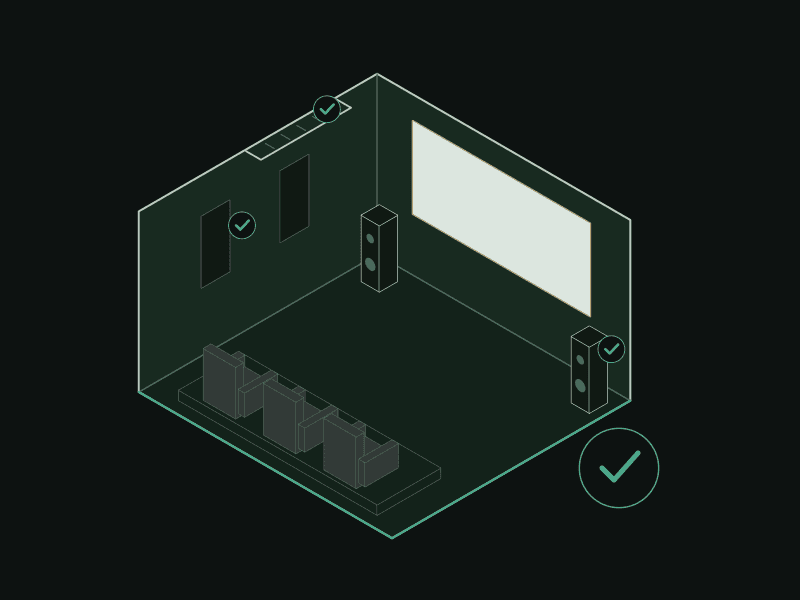
The deviation ledger
Builders and trades are rarely trying to damage the room. They are solving the problem in front of them, often without knowing why a specialist cinema detail was drawn that way. One small move becomes another. The design intent gets diluted quietly.
A cabinet shifts to clear framing, joinery or a service run; the documented geometry no longer matches the listening position.
An architectural volume becomes deeper on site and starts governing sightlines, projector paths or acoustic treatment space.
A nominated surface, cavity or finish is substituted because its construction purpose was not visible to the wider team.
A path that looked available in drawings is lost to structure, insulation, cabinetry, fire rating or another trade's priority.
Air movement, access panels or ductwork occupy the quiet zone that the room needed for performance and serviceability.
A construction adjustment changes viewing geometry, bass volume, step lighting or the relationship between rows.
A reasonable-looking alternative arrives, but nobody checks whether it still supports the design intent.
One performance journey
Kurrency is not another design stage and not an installer report. It is the evidence layer between the written intent, the built conditions and the final calibration readiness of the room.
The cinema begins as a written promise: geometry, performance targets, services, concealment, coordination and the experience the room is meant to deliver.
The integrator and project team receive the information they need to price, coordinate and protect the specialist work before construction momentum takes over.
Kolosseum looks while the room is still open: framing, service paths, cavities, sightlines, speaker provisions and acoustic zones are checked against intent.
Evidence is kept current as the specialist fit-out takes shape, so deviations are named while they can still be corrected rather than discovered later.
The room reaches the calibrator with the fundamentals intact, so final measurement and tuning can become polish instead of damage control.
The Certificate of Kurrency records how current the observed evidence is, and whether the cinema still reflects the performance intent it was designed to achieve.
For the final polish
Calibration is expert finish work. Kurrency does not compete with it; it protects the physical conditions that let it matter. When the construction, cable paths, speaker positions, acoustic zones and services still reflect the documented intent, measurement can become refinement rather than a post-mortem.
Project fit
Four questions. Answer them honestly for your project — the result is yours either way, and nobody asks for your email address.
Is one party accountable for room geometry, sightlines, acoustics, speaker placement, services and construction coordination?
Is the performance target documented before equipment is selected or tendered?
Can every relevant trade build from the same coordinated information?
Will the finished room be verified against the original design intent?
0 of 4 answered. The result appears as soon as all four are in.
Current to what we have seen
The nominated stage has been observed, and no unresolved departure from the documented intent is recorded at that point in time.
A decision, trade response or correction remains open, so the record stays current to the evidence available rather than pretending certainty.
The project changed after the observation, or a critical condition could not be confirmed, so the evidence needs to be renewed.
It does not replace the designer. It does not replace the integrator. It does not replace the builder. And it does not replace the calibrator.
It is a Kolosseum-issued record of observed project continuity at nominated stages. It is not third-party certification, accreditation or a warranty of final performance.
Where recommended practices are relevant, the work is RP22-informed and tied back to the documented performance intent of the cinema.
Certificate of Kurrency
Appointed directly or engaged confidentially behind an integrator, Kolosseum protects one thing: the performance intent of the cinema, current to the evidence we have seen.
Begin a Conversation