
Redefining Low-Frequency Reproduction
WaveForming eliminates room modes at the source. Instead of fighting standing waves with EQ and absorption, it prevents them from forming in the first place.
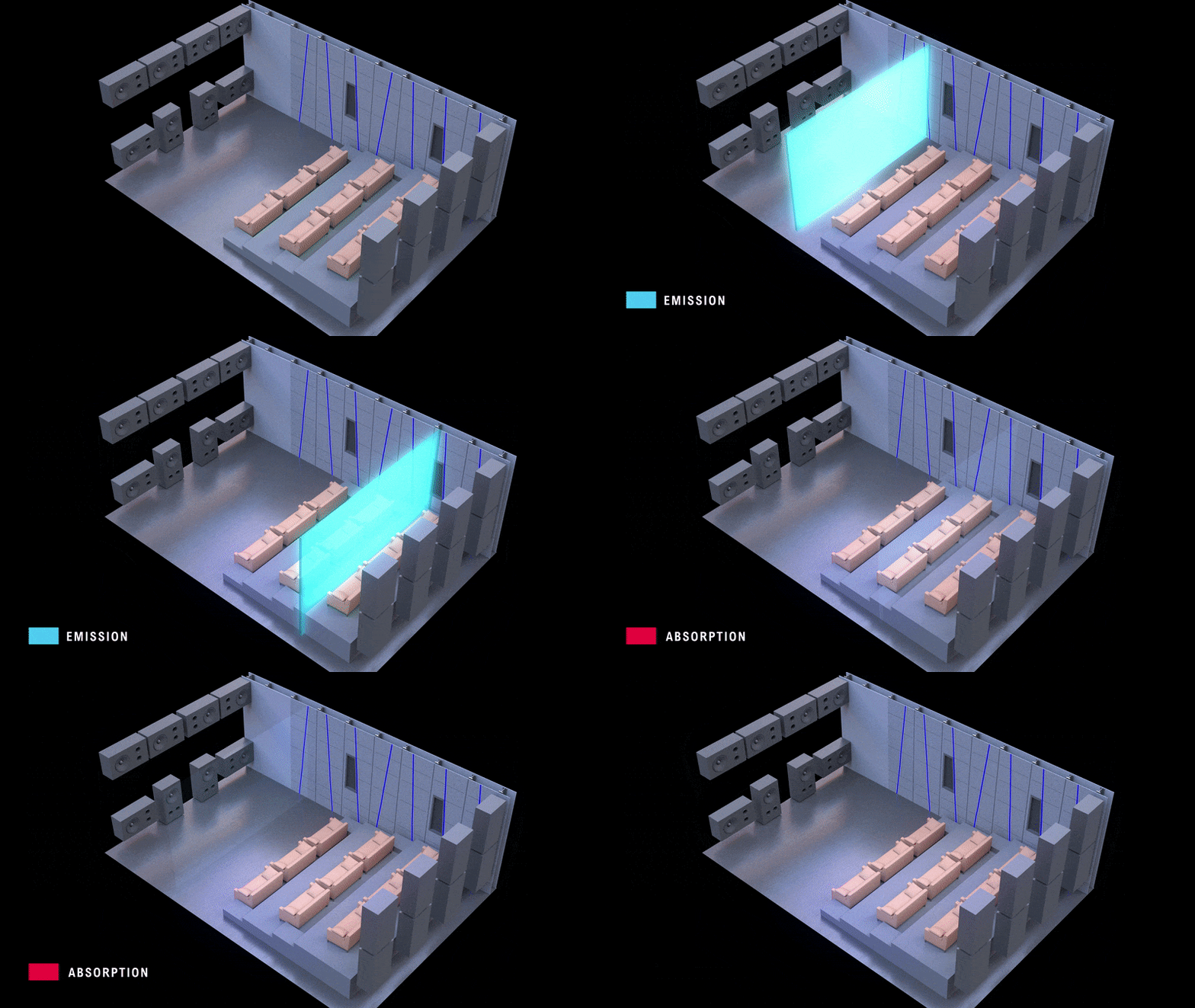
Why Bass Sounds Different in Every Seat
In any enclosed room, low frequencies bounce between parallel walls, creating standing waves or room modes. This physical phenomenon causes specific frequencies to amplify or cancel out depending on where you sit.
Traditional solutions rely on heavy acoustic absorption or basic equalization. EQ can only fix the frequency response for a single seat, often making other seats worse, and it cannot fix the fundamental problem: long decay times that make bass sound boomy or muddy.
Without WaveForming
- Inconsistent bass across seats
- Long decay times (boomy sound)
- EQ cannot fix time-domain issues
With WaveForming
- Flat response in every seat
- Fast decay (tight, impactful bass)
- Active control of room acoustics
Four Innovations Working Together
3D Acoustic Field Measurement
Every individual subwoofer is sampled across a 9-to-25 point grid using Trinnov's 3D microphone. The dense spatial map captures the full temporal and spectral behaviour of every transducer relative to every seat.
3D Wavefront Synthesis
By tightly coordinating the phase, amplitude and timing of every front-wall sub, individual spherical sources merge into one coherent planar wavefront.
Acoustic Reshaping
Using the 3D map, the algorithm computes inverse filters that abruptly halt modal decay, producing exceptional transient definition and uniform decay across every seat.
MSMC Active Absorption
Front subs emit the planar wavefront; rear subs receive it and emit a phase-inverted cancellation signal that annihilates the incoming wave.
What WaveForming Delivers
Low Decay Times
Eliminates room modes, resulting in a dramatic reduction in bass reverberation. Experience unprecedented clarity, tightness, and physical impact.
Seat-to-Seat Consistency
Designed to improve low-frequency consistency across the listening area; final performance depends on room implementation, calibration, and measurement.
Predictable Results
WaveForming is not just an algorithm; it's a holistic design approach. Following placement guidelines creates repeatable, predictable outcomes.
Subwoofer Layout Options
WaveForming supports multiple configuration strategies depending on your room constraints and performance goals.
Planar WaveForming
Regular grid layouts dispatched by room size. Highest spatial resolution and seat consistency.
Cylindrical WaveForming
Typically two subwoofers placed on the floor at quarter points. A simpler, highly effective setup for rooms where height placement is impossible.
Irregular & Reduced Arrays
Asymmetric layouts for HVAC, screen-channel or processor-channel constraints. Front-array density is always prioritised over rear.

Design & Predict Your WaveForming System
Enter your room dimensions, pick subwoofer hardware, and dial in boundary treatment. The planner computes the recommended array topology and a lower-bound SPL prediction at the listening seat.
Performance Results
Dimensions are within a layout transition zone (±15cm of a breakpoint). Consider stepping up to the next array density to maintain planar control bandwidth.
Primary Axial Modes
SPL Prediction (WaveForming Lower-Bound)
Floor assumed perfectly reflective. Side walls are modelled symmetrically per the white-paper assumptions.
Predicted band-average SPL meets the 115 dB project-model target at the primary listening seat.
Per Trinnov white paper Eq. 6 (Moleron & Haguet, 2026). Predictions assume ideal WaveForming operation — actual measured SPL will vary by ±2 dB due to filter-amplitude variance and unmodelled boundary impedance.
3D Interactive View
Wall Elevation
Layout topology follows the Trinnov WaveForming placement guide; SPL is estimated via the lower-bound model from Estimating Room SPL with WaveForming. Predictions assume ideal WaveForming operation; measured results may vary by +/-2 dB. See the Trinnov subwoofer guidelines for hardware selection. Final calibration requires the Optimizer and 3D measurement microphone.
Trinnov Altitude Processors
WaveForming requires a Trinnov Altitude-platform processor. Each model delivers the same core Optimizer, WaveForming, and 3D Remapping engine with different channel capacities.
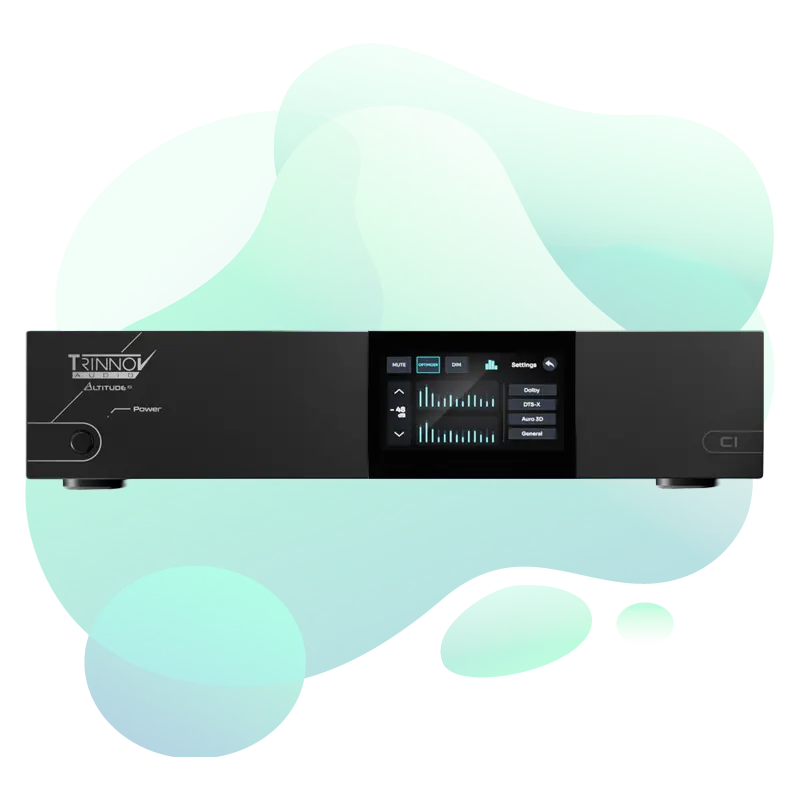
AltitudeCI
Network-First CI Processor
Scalable 8-32 channel outputs with native Dante and AES67 support. The most flexible Trinnov processor for modern integrations.
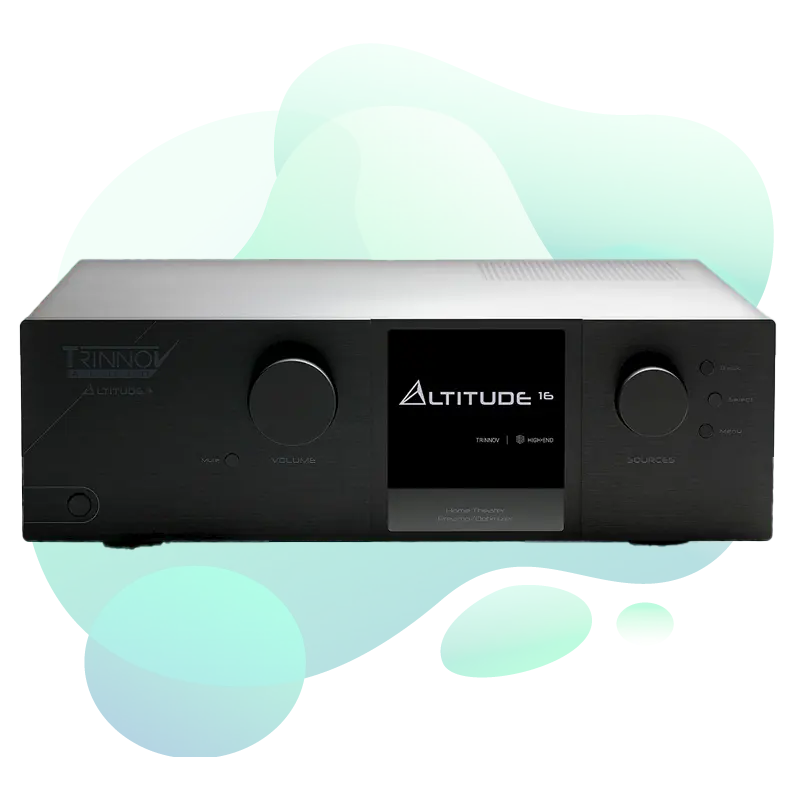
Altitude16
Reference Immersive Processor
Up to 20 discrete channels with HDMI 2.1, Dolby Atmos, DTS:X Pro, Auro-3D, and full Optimizer with WaveForming support.
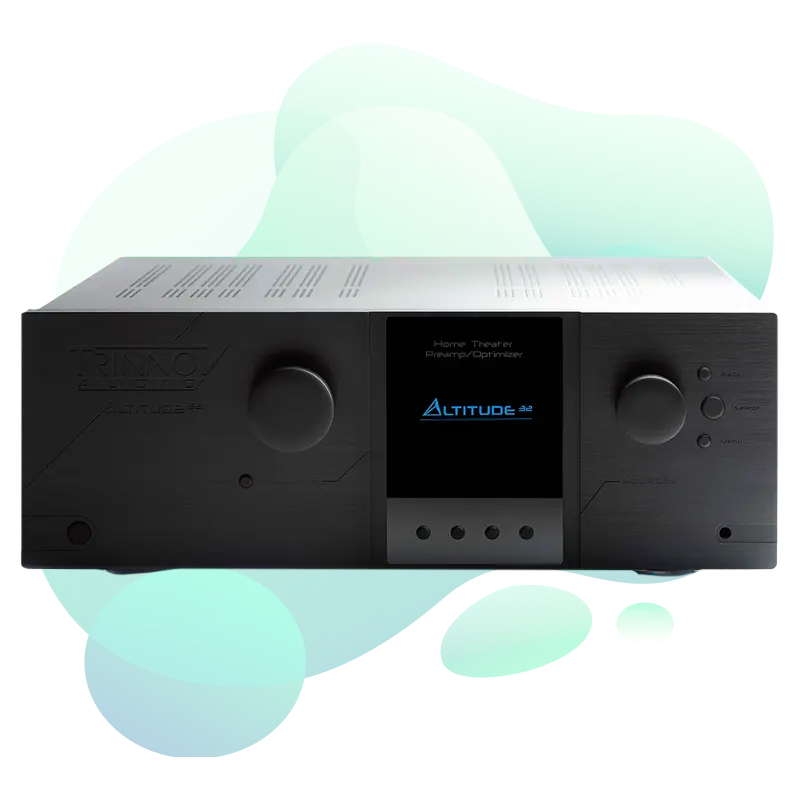
Altitude32
Flagship Reference Platform
Up to 36+ optimised channels. The industry benchmark for top-tier private cinema systems with uncompromised spatial precision.
WaveForming in Practice
Due to its engineering complexity and strict spatial requirements, Trinnov WaveForming is generally reserved for dedicated room designs. We integrate it through detailed cinema documentation and RP XXII engagements.
Explore Cinema Packages
Compare cinema documentation packages to see which drawing scope fits the room and project team.
Detailed Cinema Design
Comprehensive acoustic modelling and full CAD documentation for dedicated, high-performance rooms.
RP XXII Solution
The absolute pinnacle of home cinema design. Uncompromised engineering meeting the highest international standards.
What Industry Leaders Say
"Watching movie scenes that we have seen 100's of times left us with shivers and mouths open. Frequencies that traveled right through my body created sensations I had never felt."
"WaveForming is a huge step forward in low frequency definition and impact. The sound is the same regardless of where you sit."
"It is not often I use the term Game Changer... but after experiencing the new Trinnov technology at Krix Headquarters recently, that was precisely the term I used."
Frequently Asked Questions
Common questions about Trinnov WaveForming technology, subwoofer placement, and processor requirements.
What is Trinnov WaveForming and how does it work?
How many subwoofers do I need for WaveForming?
How is the SPL in a WaveForming room predicted?
Why do I need Sd and Xmax to predict SPL?
Which Trinnov processor supports WaveForming?
Does WaveForming work in every room?
What is the difference between Planar and Cylindrical WaveForming?
Can I install WaveForming myself?
Ready to Experience WaveForming?
Our team designs WaveForming-compatible cinema systems from room geometry through to final commissioning.